Thursday, September 24, 2009

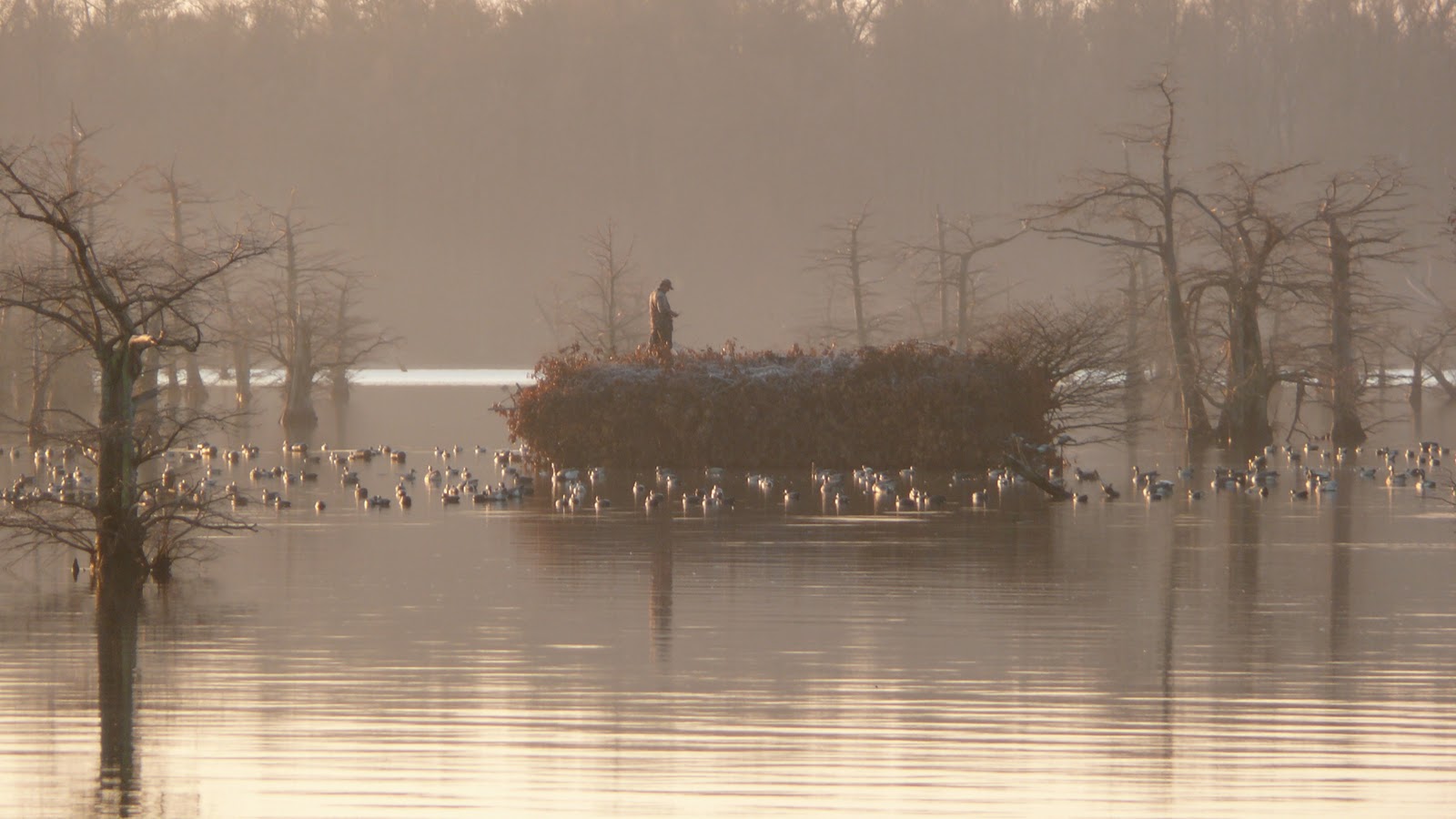
Tranquility Base: Holston River - September 12, 2009


Tranquility base here! The peace and beauty of the early morning is often my tanquility base. If that peace is to be interrupted, let it be the whistle of wingbeats or the quack of a low-flying hen cutting across the top of the fog to break the silence. And, occassionally, the thunder from the old Red Label Ruger Over and Under is a welcomed disturbance.

It was the wood duck, not the eagle that landed this mid-September morn. While peace and quiet were momentarily shattered, as surely as the sun rose, the Holston returned to tanquility base.

Labels: , , ,

Friday, September 04, 2009

Opening Day: I Am Glad

This entire summer has been more like those of my childhood than any I remember for years. The days have been mild, humidity has been tolerable, nights cool, and rain plentiful.

This time of year I associate the beginning of school and high school football with the fourth Saturday of August when squirrel season opens and September 1st when dove season opens here in Tennessee.

Unfortunately, for the last several years, it's just been too hot for me to enjoy opening day in the dove fields. My what a contrast this past Tuesday was to the normal opening day heat wave.

My friend, Danny Horhrychuk, has long held an opening day hunt and barbecue. The food is marvelous. The company is grand. And sometimes the hunting is good in spite of the heat.

This year was near perfect.

Upon arrival one is immediately greeted with that heavenly smell of hickory wood smoke lingering from smokers hard at work. Danny's picnic area runs parallel to Bent Creek so the smoke traverses the course of the creek.

The meal includes fried green tomatoes, grilled corn on the cob, cole slaw, pork of all varities, grilled chicken, smoked summer sausage, and banana pudding. The trick is to moderate the intake so the hunt can be enjoyed later.

A short walk down the trail led us to a field freshly mowed with grain plentiful on the ground. This standard agricultural practice certainly improves the numbers of doves in the area. And, there's that unmistakable smell of a field recently cut.

The next field had some of the crop tilled under. The pungent smell of earth turned over appealed to my agrarian roots.

My pulse quicken as I heard the rapid fire of shotguns as a group of doves circled the field. And I reached olfactory nirvana as I got in on the act, firing several rounds through my Red Label Ruger over & under generating that burned gun powder smell.

At times the shooting subsided allowing me to gaze about the field to take it all in. The long shadows finally confirmed fall is upon us. My primal instincts are peaked and my hunter/gatherer DNA is obvious to me during this time of year.

I am glad.

Sunday, August 02, 2009

The Box Elder Knows

We've removed many box elders during site clearing for our food plots or while cutting shooting lanes from favored tree stand locations. The trunks rarely have to be split for firewood due to small circumference. Often twisted, the wood burns quickly and isn't especially hot.

Box elder is native to portions of Tennessee and grows commonly along the banks of streams and rivers. Box elder has a soft wood that has no commercial value, but is important for wildlife and the stabilization of stream banks where it grows.

Strum Island is covered with box elders. I've passed many an hour rocking on the front porch watching bushy-tails play and finches fight in box elders.

But I've learned to appreciate one indisputable fact about box elders: their leaves are the first to turn [although an ugly brown] and slowly start a canopy that will eventually cover the forest floor.

Before the first snow, the first frost, the first cool night justifying a fire, the first dove hunt, or even the first squirrel hunt, the box elder knows - it must first loosen its grip on its leaves for their short journey to Terra firma.

Disregard the hot days. Pay no attention to the high sun angle. Behold, the box elder knows and, today, began the end of summer by casting off its browns and yellows. The box elder knows fall is within reach. I can't wait!

Labels: , ,

Tuesday, May 12, 2009

Daddies are for Making Memories: Father's Day Reflections

We dearly loved to grouse hunt. Initially, at least, it was the challenge that made their pursuit so enjoyable.

The first challenge in grouse hunting is reaching their habitat. Thick, tough under-over growth is their home. In east Tennessee’s mountains, grouse hunting dictates climbing – lots of climbing. Burning thighs at the end of the day are a guarantee.

Nor is grouse hunting for the faint of heart. Flushed grouse don’t just take off. Rather, they explode from low-lying brush in which they hide with a force and sound rarely experienced by bird hunters. There is anticipation when a good dog points a grouse. Yet even with that early warning, the startle from this wary creature’s launch skyward is unavoidable. To this day I marvel at how a grouse instinctively flies out of the woods never giving a hunter a clear shot through the trees.

A single grouse in the pouch of one’s hunting vest symbolizes a good day. Two grouse constitute a great day.

There were other reasons grouse hunting had our affection. Neither of us could name a meal we’d rather eat than baked grouse, gravy and dressing.

The Tennessee hunting season on these primo birds runs from mid-October to the end of February. Rarely did we ever hunt them until the leaves were off the trees in late October. Grouse hunting helped Dad get in shape for the coming rifle season for deer. In those days, successful deer hunting also meant lots of climbing in east Tennessee’s high country.

When I went of to college at the University of Tennessee at Martin in the early 1970’s, my fall hunting was limited to duck. The season opened about the same week as fall quarter finals. Before coming home to east Tennessee for Christmas break, I would take a few days to hunt with my college mates on Reelfoot Lake, on the Mississippi River, or on the Tennessee River and its tributaries in rural west Tennessee. But Dad and I continued to get in a grouse hunt during those holiday breaks.

From college it was off to graduate school and then law school in Memphis. There was more duck hunting in west Tennessee and Arkansas but less time at home in east Tennessee for grouse hunting with Dad. As my law practice was beginning in Memphis in the early 1980’s, this trend continued so there were fewer and fewer opportunities for a grouse hunt with Dad.

Slipping away for a weekend grouse hunt in east Tennessee in February was a great way to stay in the field after duck season had ended in late January I thought; but
this particular February was different. Both of us knew he was suffering from prostrate cancer. Ostensibly, I was making the trip home to grouse hunt with Dad. Privately, I knew I was making the trip to just be with my dying father.

I had no idea how badly he hurt. Then I wouldn’t. Some accused him of being overly private. In all our years, it was the rarest of moments when Dad would share with me one of his emotions or, even rarer, how he felt from a physical standpoint. In the whole of his life, it was never about him. My imagination can’t conceive of a more selfless man.

As usual, he didn’t say much during the half hour drive from our home in Church Hill to the farm where mom grew up in War Valley. But, he didn’t have to say much that day. The trip was heavy-laden with fond memories he had made for me. Down Goshen Valley a ways we passed the old pear tree were I helped him gather overly ripe fruit for making pear butter as we squirrel hunted. Just a bit further down the road we saw the briar thicket where we flushed rabbits in the winter and picked blackberries in the summer. Blackberry cobblers were his favorite dessert.

We turned off of Beech Creek Road at the dam for Mowl’s mill, the place where, to Dad’s delight, I caught my first fish some twenty-five years earlier. One mile up the graveled road, we turned at the old spring house where, after milking, the raw milk was stored in old milk cans awaiting retrieval by the dairy company.

When Dad suggested I climb the ridge alone, I had my first hint as to how much he hurt. He could always walk my legs off traversing those ridges as we hunted together. Under his new strategy, he would wait until I got to the top of the ridge, then he would walk parallel to me along the hollow as I walked the ridge top in the same direction. If I flushed a bird downhill, as grouse are prone to do, we might both get a shot.

Sure enough, I flushed a bird emptying all three rounds at the grouse as it dove down hill toward the hollow. He didn’t shoot but I heard Dad yelling. Though in my late twenties, I felt boyish-pride for having succeeded with my father watching. I just knew I had bagged a coveted ruffed grouse.

Was I ever wrong! Even in his weaken condition, Dad had moved farther ahead of me than anticipated and was peppered by the birdshot from one of the rounds I fired. While he wasn’t injured, he used the incident to once again teach his cardinal rule of hunting – “there is no substitute for safety first; no matter what!” His role as my teacher never ended.

Neither of us killed a grouse that day. But our day reminded me time and time again what a profound influence he had been in my life.

Daddies are for making memories. As it turns out, that hunt some twenty-seven years ago was the most memorable hunt we ever had. It was our last.

First published in Midwest Outdoors June, 2009

Monday, March 30, 2009

Who is the Turkey Now?

Up early and on the stand before the first crack of light was my strategy. We knew there were birds roosting on the north end of the island. The salient question was: in which direction would their path take them when coming off the roost?

At 7:30am I heard the distinctive blast from a shotgun in the general direction where Art had set up. "One down; one to go", I thought. But by 8:00am nothing had stirred within my area of view.

Hearing rustling leaves on a windless morning tipped me off. The sounds came from the ridge that terminates on the other bank of the sluice some 150 yards from my position. Without detection, I moved the 80 yards from my ground blind to the sluice duck blind which is on the island side of the river some 50 yards from where that ridge ends.

I no more than sat down when it happened. From behind me, "gobble, gobble, gobble"!As I peered through the crack in the rear of the duck blind, I saw a large tom turkey that was headed straight for the three decoys I had set out in the food plot and within easy range of my former location - the ground blind. When I spotted him he was less than five yards from where I had been seated.

From "Turkeyese" to English the loose translation was of those three gobbles I had just heard was "Who is the turkey now". I wish old Tom weren't so fluent in "Turkeyese". I can't print my reply to Mr. Gobbler.

Monday, January 05, 2009

Reelfoot Redux


Starting the year out right. Reelfoot Lake, Tennessee. January 2-4, 2009.

Labels:

Wednesday, December 31, 2008

Reelfoot Thriller


Scratching out a high limit of six ducks here in east Tennessee has always been a challenge. But in recent years, I just haven't had one of those days. For the thrill of a "limit-type" day, one must go where the ducks are.

Reelfoot and I were introduced in the fall of 1971 when Art Swann, Ken Walker and I came to know one another as freshmen at the University of Tennessee at Martin. Its proximity to the campus made Reelfoot Lake a favored destination for those of us prone to leave, rather than return to, our dorm rooms at 4am.


Most years since 1971 I've returned for a weekend or two during duck season. As far as I'm concerned, they can rename the lake "Thrillfoot". The shear number of ducks I saw this past weekend made me smile, raised my blood pressure, and gave me tachycardia.

Our blind was on the world-famous "firing line" abutting the refuge. Over the course of the day on Sunday, I'd estimate we were able to fire upon 10 or more flocks of ducks. The smorgasbord of ducks included mallards, widgeons, jacks, bluebills, pintails, gadwalls, snow geese and Canada geese. To work into firing range that many flights for all in the blind to have a reasonable shot was quite an accomplishment considering we used no professional guides for our hunt.


Other than the last day of the season, daily hunting ceases on Reelfoot at 3pm. Flight after flight after flight left that refuge a little early on Sunday beginning about 2pm. Hardly any of those leaving for their evening meal were interested in the diversion we offered. The sight nevertheless stirred my hunter soul.

While there was no way to reasonably count how many birds we saw in that last hour, I know my mind was fully occupied watching it all. When birds cover one's entire perpherial vision, counting is the last thing on your mind. Rather, it is occupied with prayers of thanksgiving: thanks for eyes to see it and thanks for those who came before me with sense enough to preserve it so I could see it.

Thursday, November 13, 2008

Neck Shot? Now I Don't Know!

Brother Loy has often advocated taking a neck shot on deer if at all possible. He reasons an accurate shot will drop the deer cold. Little meat is ruined by the shot [neither of us are neck roast fans]. And, there's very little blood.

He further reasons if one is a little high with the shot, breaking the spine is likely. If one is a little low with the shot, the jugular will be severed. And missing high or low by more than a little will result in a clean miss with no injury at all to the animal.

I followed Loy's admonitions on Saturday. The handsome four-pointer dropped in its tracks after a 62 yard shot from my CVA Optima Pro smoke pole. I re-scoped the deer and watched its final kicks. Since it was noon, I decided to return to the cabin for a bit of lunch before soiling my hands while field dressing the deer.

Returning less than an hour later I was shocked. There was no deer where he dropped. There was no blood. There was no sign the deer had ever been there. I searched for nearly two hours for a blood trail. Nothing!

This story was shared with one of our normal hunting partners Saturday evening. He repeat a story with a slightly better outcome.

Rick reported watching a deer's last kicks. After waiting a few minutes on a west Tennessee buck to expire, he headed for the carcass. After taking four steps toward this buck, the deer jumped to its feet and ran. Luckily, he had reloaded and was able to drop the deer with a quartering shot as it ran off.

Now, there's that seed of doubt in my mind about neck shots!

Labels: , ,

Tuesday, February 12, 2008

Get Your Wood Duck Boxes Ready Now


By Mike Faulk

As another duck season comes to an end, it is a good time to start thinking ahead to the early wood duck season next fall. We are all aware of the national conservation efforts of Ducks Unlimited, Delta Waterfowl and other organizations. But, frankly, there is no substitute for taking care of our conservation duties here at home. Placing and maintaining wood duck boxes in the first two weeks after the end of duck season will serve dual purposes of practicing conservation locally and providing more birds for the early fall hunt.

Wood ducks begin breeding and nesting here in the Tennessee valley in mid-February. It is common for wood ducks to produce two broods per season. Incubation takes about thirty days. The chicks leave the nest in about twenty-four hours after hatching. They become independent in 56 to 70 days and sexually mature in a year.

In nature, nests are built in cavities of trees near water and are lined with wood chips and down. About ten eggs are normal. Often nests will have many, many more eggs because other females will lay their eggs in the same nest. Biologists call this egg-dumping. One method that helps alleviate egg-dumping is the addition of man-made wood duck boxes.

While recommendations vary, wood duck boxes should be no closer together than fifty feet and optimally should be about 600 feet apart.

Prefabricated wood duck boxes can be purchased on any number of internet sites.

I prefer the plastic boxes available through Ducks Unlimited. Their color seems to match the color of many of the trees that overhang the stretch of the Holston River I usually frequent.

Additionally, the oval shape of the Ducks Unlimited plastic box, in my opinion, more nearly mimics shapes found in nature. How often do we find right angles in any of nature’s creation? Finally, the bulb-like shape of the top of these plastic boxes where the entry hole is situated looks to me more like a natural cavity in a tree.

These boxes have cotter pins that hold the two hinged halves of the box together. Inside there’s a tray for the fodder. This design diminishes the height one must climb to maintain the box and otherwise allows for easier access inside the box.

Ducks Unlimited has a link to an excellent set of plans and specifications if you choose to build your own boxes. Cedar is an ideal building material because of its natural resistance to weather and insects.

Site selection is very important with proximity to water as the key. For hatchlings there is an inverse relationship between survivability and the distance to the water from the nest. Ideally, a hen would like her chicks to drop from the nest into the water.

A forested area near slow-moving or standing shallow water with the natural protection of a cove and the existence of cover are essential. Log falls and other woody debris adds a degree of safety sought by nesting hens. Shoreline vegetation and availability of invertebrates that provide protein for the hens and ducklings enhance the desirability of a site.

A balance between the needs of the ducks and your needs as a manager of this wood duck micro-habitat must be struck in box placement. Face the box toward water so it can be seen by the ducks while swimming and flying. A clear line of sight will allow a clear line of flight. Trim limbs if necessary.

Place the box high enough above ground to avoid spring high water levels and curiosity seekers. But don’t put the box where it is difficult or dangerous to access for future maintenance. Six to twelve feet off the ground seems to fit this standard.

Boxes should be mounted vertically and, if possible, pitched slightly forward. Tiny toenails on their webbed feet allow wood ducklings to climb out of the box. A rough interior box or a wire mesh “ladder” inside the box fastened and below the entrance hole will aid the hatchlings in “flying the coop” so to speak.

Ready-made boxes allow for this exit strategy in their design but sometimes manufacturers of these boxes give inadequate instruction on affixing the boxes to trees. Through trial and error, I’ve found a backing board useful. As trees grow, boxes nailed to trees tend to come loose or come apart. Attach a backing board to the tree and the box to the backing board with lag bolts eliminates this issue and allows for easy removal for maintenance or relocation.

Cavity nesting ducks, which also include goldeneyes, hooded mergansers, common mergansers, and buffleheads, do not carry nesting materials. Wood shavings bought from the local pet or farm store will help them out. Chicks can smother on sawdust. A four to six inch insulating layer of small-sized chips should be about right. Too small a layer and there is not enough insulation. With too much of a layer, the hen sits too high on the nest. She may become the next meal of a raccoon or mink.

Predation is the number one enemy to healthy duck populations. Studies show eighty-five to ninety per cent of wood ducklings do not survive. Besides raccoon and mink, other predators include black rat snakes, great horned owls, and red and grey foxes. An easy way to minimize predation is the attachment of a two to three feet wide piece of thin sheet metal wrapped around the trunk of the tree.

Care should also be taken in placement so the box cannot be accessed from overhanging limbs and branches. A little extra effort in trimming overhanging and nearby limbs used by predators to access the box will improve survivability considerably.

Annual maintenance of your wood duck boxes should include the pruning of branches that allow access to the box by predators and prohibit access to the box by flying ducks. Clean out the box each season and refresh the nesting material. Move boxes that have not been used in a couple of seasons or first try adding predator guards to unused boxes.


Install and maintain your wood duck boxes with a partner. Most boxes will be placed in a remote location. More than likely you will be on a ladder installing or maintaining the boxes. If you place your boxes near a stream, natural hazards are plentiful. Wear leather gloves.

I learned this last safety admonition the hard way. To reach my box in a two-forked tree, I had to hold on to one fork while reaching into the wood duck box that was mounted on the other fork to clean it out. Unable to see directly into the box, I grabbed a handful of debris that turned out to be a small barn owl. I’m not sure which of us was scared more. I do know I tumbled out of the tree and rolled into the water’s edge!

From the very beginning of my hunting days, dad taught me “good hunting begins with good conservation.” Helping Mother Nature with the wood duck population will accomplish the dual purpose of improving duck habitat and proving an adequate excess for hunting purposes. Maybe more importantly, installing and maintaining wood duck boxes provides a perfect opportunity in the field to involve your youngsters in the outdoor business of conservation. Sons and daughters are perfect assistant wood duck micro-habitat managers.

Labels: , ,

Thursday, January 03, 2008

Finally: Winter Returns to the Blue Ridge


We finished out the last two days of deer season at the cabin on Strum Island arriving on New Year's Eve full of anticipation and sadness.

With a Calgary Clipper on the way scheduled to arrive on New Year's Day, we were just sure the deer would browse before the cold and snow made their appearance. And, in these two days another season would draw to a close.

Temperatures fell throughout the afternoon of the 31st to an overnight low [that also became the high temperature thus far for the new year] of 36 degrees. New Year's Day saw steadily declining temperatures but no movement by wildlife. All wild creatures, large and small, were hunkering down. My day ended as two does on the run passed me along side the main channel of the Holston River.

14 degree temperatures and a white landscape greeted us Wednesday morning - the last day of the season. Had there been any movement it would have been easy to detect. Slipping through the 1"-2" snowfall was as quiet as could be - with the blanket of snow smothering the usual crunch and snapping of twigs.

I decided to circle the entire circumference of the island to see what tracks led on to and off of the island. It also seemed a pretty good strategy for staying warm. The only tracks found were from the main channel of the river, with the wind, and into the last food plot with greens. Sure enough, does had worked over that patch of greens.

Our season ended without any new racks for the wall. But the freezer has ample venison from a doe taken during bow season. And, we're better for having spent time together, time in the woods, time being the hunter/gatherers we've been since the creation of man.

The more I'm in the woods, the more I know hunters and fishermen are the true stewards of our environment - the ones who have some understanding of the actual nature of the natural world.

Academics Blogs - Blog Top Sites